Junior Ezeonu: Texas House's Youngest Legislator
Public Service, Community Leadership, Arlington Politics
Junior Ezeonu: How Arlington’s Youngest Community Voice Became Texas House District 101’s Youngest Legislator
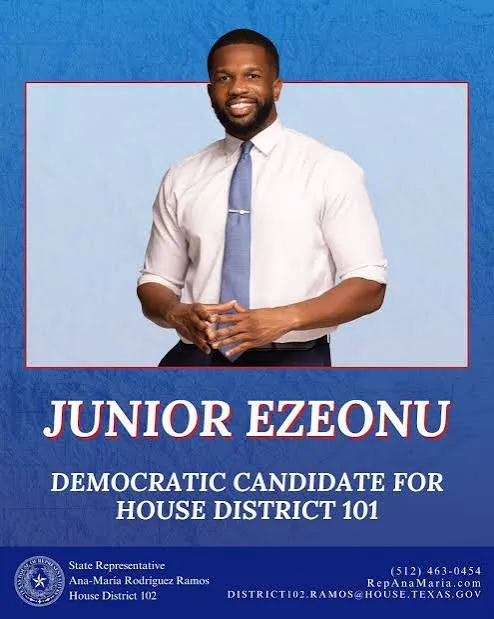
For nonprofits, neighborhood coalitions, and civic leaders, the rise of Junior Ezeonu is a case study in what happens when community-rooted engagement meets bold, youth-driven political leadership. As the Texas House District 101 Representative-elect and the youngest legislator in the Texas House, his journey from Arlington kid to state leader offers a roadmap for building authentic power from the ground up.
From Arlington Roots to Community Leader in Texas House District 101
Born in Onitsha, Nigeria, and brought to the United States at just two years old, Junior Ezeonu grew up in the neighborhoods of Arlington, Texas that he now represents. Raised in local public schools and shaped by the hopes and struggles of immigrant and working families, he developed an early awareness of how policy decisions ripple through everyday life—classrooms, parks, small businesses, and church communities (UTA).
That grounding in Arlington politics is central to his story. Long before becoming Texas State Representative-elect for District 101, Ezeonu was knocking on doors, attending neighborhood meetings, and listening to residents describe the gaps they saw—in youth opportunity, affordable housing, transportation, and access to healthcare. His eventual victory over eight-term incumbent Chris Turner in the 2026 Democratic primary, winning 53% of the vote, was not a sudden upset but the culmination of years spent building trust, especially among younger and often-overlooked voters (Texas Election Results, 2026).
Educational Foundation: Policy, People, and Purpose
For nonprofits and civic organizations, Ezeonu’s academic path underscores the value of pairing lived experience with formal training. He attended the University of Texas at Arlington (UTA), majoring in Political Science and graduating summa cum laude in May 2021 (UTA). His coursework gave him a strong grounding in governance, public policy, and political theory, but he consistently linked those ideas back to the communities he knew best.
While many students treat political science as an abstract discipline, Ezeonu treated it as a toolkit. He studied how budgets are written, how coalitions are built, and how marginalized voices can be amplified through institutions. This mix of rigorous academic preparation and personal commitment to equity now informs his priorities in the Texas House District 101: raising the minimum wage to $15 an hour, protecting public education funding, expanding healthcare access, and strengthening housing affordability (Vote Texas Values).
Early Public Service: From City Council to Mayor Pro Tem
Ezeonu’s public service career began remarkably early. In May 2021—less than a month after graduating from UTA—he was elected to the Grand Prairie City Council (Place 8, At-Large) at age 22, becoming the youngest councilmember in the city’s history (UTA). For nonprofits and community groups, this milestone illustrates the power of supporting young candidates who already have deep neighborhood ties.
On the council, Ezeonu quickly moved beyond symbolism and into substantive leadership. By 2025, he had served as Mayor Pro Tem of Grand Prairie, chaired the city’s Finance and Government Committee, and helped oversee key budget decisions and financial updates (Grand Prairie City Records). He championed investments that reflected community input, including funding for a cricket pitch and pickleball courts—amenities that speak to the city’s growing diversity and changing recreational needs.
Beyond city limits, Ezeonu earned appointments to national bodies within the National League of Cities, including the Energy, Environment, and Natural Resources Federal Advocacy Committee and the Race Equity And Leadership (REAL) Council (NLC Appointments). For organizations working at the intersection of climate, equity, and local governance, his trajectory shows how municipal leadership can quickly scale to statewide and national influence.

Leadership Qualities Nonprofits Can Partner With
As the youngest legislator in the Texas House, Junior Ezeonu brings a leadership style that many nonprofits and community-based organizations find both familiar and refreshing. Several qualities stand out for groups seeking meaningful partnerships with elected officials:
Community-first decision-making: His policy agenda—on wages, housing, public education, and healthcare—grew directly from conversations with residents, volunteers, and local advocates, rather than from top-down party talking points (Vote Texas Values).
Youth engagement and political education: Early in his career, he launched a YouTube channel to explain politics, government, and economics to young people, demystifying processes that often exclude first-time voters and emerging leaders (UTA).
Equity-driven vision: His service on the National League of Cities’ REAL Council reflects a sustained commitment to racial equity, not just as rhetoric but as a framework for budgeting, program design, and policy evaluation.
Courage to challenge the status quo: Unseating a long-serving incumbent and former House Democratic caucus chair required strategic organizing, coalition-building, and a willingness to articulate a different future for Texas House District 101 (KWTX).
💡 For nonprofits: Ezeonu’s path shows the impact of investing early in young, values-driven leaders and inviting them into coalition work long before they run for higher office.
What Junior Ezeonu’s Story Means for Community Engagement
For organizations focused on community engagement and political leadership, Junior Ezeonu’s journey offers a compelling blueprint. He demonstrates that the path from neighborhood advocate to Texas State Representative-elect is not reserved for insiders—it can be forged by those who start with listening, learning, and serving locally.
Whether you are mobilizing youth, building coalitions in Arlington politics, or seeking champions for your policy agenda at the state level, leaders like Junior Ezeonu show how deeply rooted, community-centered public servants can reshape institutions from city hall to the Texas Capitol. His story is not just a personal success—it is an invitation for nonprofits and communities to cultivate, support, and partner with the next generation of community leaders and public servants across Texas and beyond.